Quiz: Which changemaker are you?
There isn’t one way to change the world. There are all different kinds of people who use their unique skills and mindset to make a difference. Available in Dutch and English.


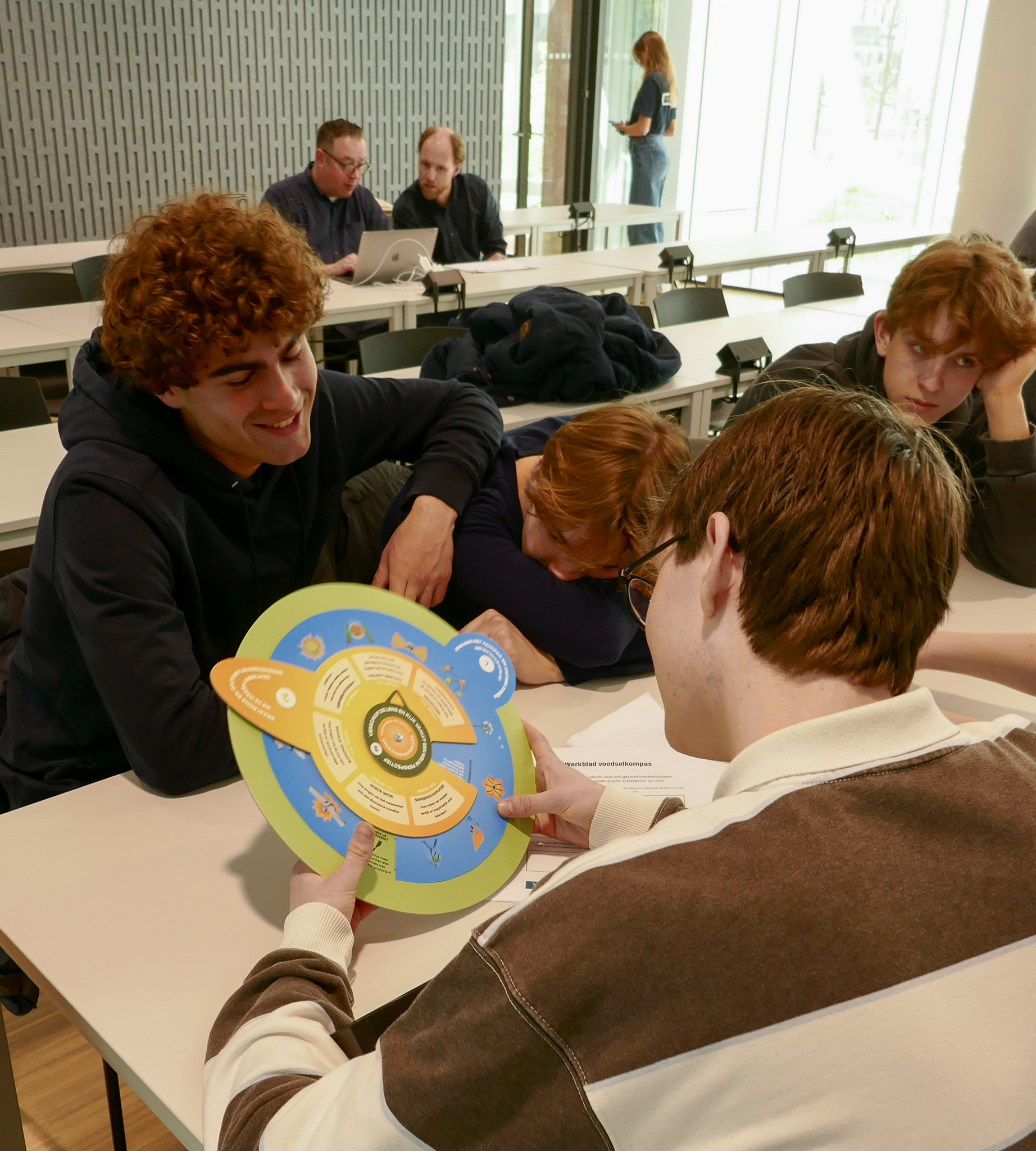
We took the Food Compass of Change out for an excursion. The Food Systems Change Compass was originally designed for the Dutch Design Week of 2024. Together with TechnoTrend Foundation, we tested the new portable Food Compasses during a Climaton, a climate-themed hackathon organised with the Leiden University Green Office.
Around 30 students used the compass to develop their own initiative, inspired by current transition innovations and the students' own interests, thoughts and capabilities. The compass, together with a workshop canvas with additional questions, challenged them to come up with an initiative that promotes sustainable values like locality, zero waste, biodiversity and stewardship. At the end of the day the kids pitched their ideas.
This was the first of what we hope will be many more workshops, and with that in mind, taking a moment to reflect felt worthwhile. Three insights stood out, each pointing toward something we might do differently next time or obstacles worth addressing.
Sustainability has become a word that signals good intention without requiring much precision. In workshops like this, that vagueness can quietly stall progress: everyone nods, but no one is quite sure what they are agreeing to. The compass tries to sidestep this by making initiatives concrete from the start. This is how kids came up with the idea not of "a more sustainable canteen", but "a canteen where students vote on the menu once a week". Specificity creates ownership. It also makes ideas easier to challenge, refine, and eventually realise.
But the issue runs deeper than vocabulary. When young people grow up hearing sustainability as an abstract ideal, it can feel like something that belongs to institutions, experts, or the future, and not something they can shape today. Reframing the question from "how do we become more sustainable?" to "what would you actually change, and for whom?" shifts that dynamic considerably.
For future workshops or other educational endeavours addressing food systems, it could help to make this explicit early on, perhaps through a simple constraint: describe your idea without using the word "sustainable" at all. If you strip away the label, what is the idea really about?
The compass is built on a simple but important premise: that people are most creative, most committed, and most realistic when they are designing for a world they actually inhabit. During this workshop, that foundation was put under pressure. The assignment had been brought in by an external partner, with the best of intentions, asking students to develop ideas for a context outside their own daily lives. The result was a kind of consultancy trap: students generating advice for a system they had no real relationship with, no prior research into, and no stake in maintaining.
This showed up in the ideas themselves. Many were ambitious in scale but thin on grounding, and when asked practical questions like "who would maintain this?" or "who would clean it up?", the answer was often simply: "volunteers." Not because the students lacked intelligence, but because they lacked the friction that comes from knowing a place and its people. Without that, the personal connection the compass tries to unlock had nowhere to land.
The case holder was also absent - due to capacity reasons - until the part where they had to critique the final idea, which meant there was no one to ask the sharp, concrete questions early on that might have pushed ideas toward greater realism and depth.
The decision to keep an assignment broad is not inherently wrong, but it works very differently depending on whether students are designing for their own environment or acting as outside advisors. Conflating the two approaches quietly undermines both. A clearer choice needs to be made upfront, because it shapes not just the quality of the ideas, but the entire attitude students bring to the work.
For future workshops, this could mean either grounding the brief firmly in the students' own context, or, if an external case is used, equipping them with tools to genuinely enter that world first: interviews, co-creation, or direct conversations and tests with users and stakeholders. The goal is to prevent ideas from floating free of the communities they are meant to serve.
One of the more unexpected observations concerned the dynamic between young boys. The boys sat together, loud and irreverent, answering the compass questions with humour and a kind of teasing nonchalance. The girls worked quieter and more attentively. Two very different energies in the same room. It was a deliberate choice by the teachers to let students form their own groups: mixing them risks making some quiet or passive, but keeping self-selected groups comes with its own challenge, maintaining focus without flattening the energy that makes the work lively.
What struck me was that the humour did not always get in the way of the quality of ideas. One group built an entire proposal around the fact that someone among them was apparently a great cook. I still am not sure whether it started as a joke, but they ended up genuinely exploring how he might cook his’ famous’ pea falafel at school. The laughter and the logic were hard to separate. These students were quick, creative, and surprisingly persuasive. They knew each other well, were unafraid of new ideas, and could hold their ground when challenged.
The tension came when teachers dismissed ideas that did not look serious enough on the surface. Understandable, but it risks flattening exactly the qualities that make young people good at this kind of work. The question is not whether an idea sounds serious, but whether there is genuine intent behind it.
Going forward, it could help to build in a moment that asks students to cross that bridge themselves, to take their own idea one step further and answer: would you actually do this? Not as a test, but as an invitation to own it. A short commitment question, a peer challenge, or a simple "if this were real, what would your first step be?" can shift the dynamic from performance to investment.
These three insights point back at us as much as they point at the students. How do we design tools and workshops that resist the comfort of vague language, and instead create the conditions for specificity and genuine ownership? How do we ensure that the contexts we invite people to design for are ones they can truly inhabit, rather than observe from a distance? And how do we hold space for the irreverent, the playful, and the not-yet-serious, without letting the energy dissipate before it becomes something real? These are not questions with clean answers, but they seem worth carrying into next iterations of the Food compass + workshops.
My dream for the Compass is that it empowers students to design and implement their own interventions within their schools. I know this requires far more effort and commitment than hosting a single workshop — which is why I'm looking to partner with schools that are ready to invest in this longer-term challenge.
If you have thoughts on these reflection points, feel free to share them. If you want to use the compasses or undertake some action, my mail box is open for you.

There isn’t one way to change the world. There are all different kinds of people who use their unique skills and mindset to make a difference. Available in Dutch and English.
Earthlings is an interdisciplinary project platform seeding new forms of public participation that better equip society to respond to the systemic impacts of the climate crisis.
Announcing our pilot project with the Fitzwilliam Museum
Reflections on co-designing new public digital landscapes with care communities
.jpeg)
We were featured on the sixth episode of the podcast Feeling Futures.
Bodemkracht: A week of feeling through food systems on a farm in Zeeland